Home Blog Page 330

Hero cops praised for saving girl who choked on sweet

0

Police officers were praised for their swift actions yesterday as they leapt to the rescue of a girl who had choked on a sweet.

Aaron Kincaid and James Blundell were first on the scene to a house in Tameside where they found the girl was struggling to breath and coughing up blood.

First aid in full effect

To the huge relief of the girl’s distressed parents, PC Kincaid utilised his first aid training to full effect, successfully dislodging the sweet from the girl’s throat and helping to calm her down before paramedics arrived.

Whilst PC Kincaid tended to the child, PC Blundell did everything he could to help the parents remain calm. Upon arrival, paramedics took over and the young girl was taken to hospital as a precaution.

Superintendent Mike Walsh from GMP Tameside district said: “PCs Aaron Kincaid and James Blundell acted without hesitation during the incident and took control of the situation that they were faced with.

“They deserve every credit for staying calm under extreme pressure and for working together as a team and utilising their training to lifesaving effect. I am sure the girl’s parents and family will consider the officers to be absolute heroes.

Right place, right time

PC Kincaid said: “We’re both glad that we were in the right place at the right time.

“I have a daughter the same age as the little girl who needed our help, and I cannot tell you how much of a relief it was when she started breathing normally and said she was okay after I had managed to dislodge the sweet.

“I remember saying, ‘Thank God for that’.

“The little girl gave me a thank you hug before she went to hospital, but I couldn’t have done what I did without PC Blundell’s assistance. It was a real team effort.”

Northern mayors to go head-to-head in charity DJ battle in Liverpool

Mayors Andy Burnham and Steve Rotheram are set to face off against each other in a massive DJ Battle fundraiser in Liverpool.

The pair will take to the decks on February 2 at Camp and Furnace, as Greater Manchester and the Liverpool region go head-to-head in a good-natured music battle, all for a worthy cause.

The charity event will be somewhat of a round three re-match for the pair, with their first clash taking place online during pandemic and an award-winning follow-up in Manchester in December 2022 raising over £25,000.

Proceeds from the night will be distributed between the Liverpool City Region and Greater Manchester charities, with all funds supporting initiatives to tackle homelessness and end the need for rough sleeping.

Helping the homeless

In the Liverpool, proceeds will be directed to homeless charities across the area through Community Foundations for Lancashire and Merseyside.

In Greater Manchester, the money will support A Bed Every Night, Greater Manchester Mayor’s Charity’s flagship ongoing programme to provide emergency wrap-around support to those rough sleeping, offering guaranteed food and shelter.

Tickets released soon

Tickets for the February fixture are set to be released soon, with people urged to follow the charities’ and the Mayors’ social media accounts to be the first to know.

Andy Burnham, mayor of Greater Manchester said: “We’re coming back but this time we’re heading over to Liverpool. I was so proud of what we achieved with our DJ Battle last year, using the power of music and friendly rivalry to unite behind one powerful message, that homelessness has no place in Greater Manchester. It’s going to be bigger and better this time round, as we spread the fundraising and ramp up the noise over in Liverpool.”

Steve Rotheram, mayor of the Liverpool City Region, said: “I’ve long said that our region is the undisputed home on British music and I’m looking forward to going head-to-head with Andy to settle this debate once and for all. Best of all, this year’s contest is on home soil!

“Despite all the light-hearted jokes we make about regional tribalism, we were absolutely blown away by the support and generosity of everyone who got behind last year’s DJ battle and donated to such a cause that’s very close to all our hearts. Afterall, the measure of any decent society is how it treats its most vulnerable citizens – and we’re showing that the North West will always stand united in support of those who need it most.”

Last year’s celebration at Manchester’s Mayfield Depot saw Rowetta, Nihal Arthanayake, Stanley Chow and Clint Boon show up for Manchester, whilst Team Liverpool boasted Peter Reid, Ian McCulloch, The Farm, and actress Sue Johnston.

It famously saw Labour’s deputy leader Angela Rayner MP swap the despatch box for the decks, with a now viral clip of her spinning N-Trance’s ‘Set You Free’.

Friendly rivalry

It’s all part of a concerted and creative effort to tackle the challenge of homelessness across the region. The current financial crisis is seeing communities facing increasingly tough challenges.

The Greater Manchester Mayor’s Charity remain resolute that they can address the challenges against increasing adversity, with campaigns, events and challenges that have to date raised millions.

Tim Heatley, chair of the Greater Manchester Mayor’s Charity, said: “The last DJ battle was epic. It ramped up the friendly rivalry between the two city regions and saw the Mayors and region’s cheerleaders all giving up their time for a common goal.

“Music has the power to unite communities and these head-to-heads have shown the willingness of music-lovers to put their hand in their pockets, support a worthy cause and have a great night in the while doing so. We’re getting warned up for Liverpool and can’t wait to bring the party to the city.”

Image credit: Shaun Peckham


Embracing the era of real-time payments

0

In many areas of life today, people expect instant gratification.

The incumbents of the banking space have been slow to adapt to this new reality, but things are beginning to change.

Both businesses and consumers all over the world are quickly realising the importance of speed and convenience in transactions, and new businesses and technologies are sprouting up to fill the demand.

The evolution of real-time payments

Historically, payment systems in the traditional finance world were bound by bank hours and processing times that could often span several days. The digital age allowed for fund transfers to commence electronically, yet these often fell short of real-time capabilities, as well. Even today, some banks still won’t process a transfer made after business hours until the following morning.

Despite this, there have been many advances in technology that can help facilitate real-time payments. The way that APIs have evolved has revolutionised the way that different financial institutions can interact with one another, and digital ledger technologies have allowed for more transparent recordkeeping. Advanced predictive analytics has been important, too, as a means of quickly identifying fraud and assessing other risks.

This has led to different solutions rolling out in different parts of the world. The Central Bank of Brazil introduced the PIX system that enables 24/7 instant payments, while in Sweden, Swish allows both individuals and businesses to send money instantly with just a mobile number. India has the Unified Payments Interface (UPI), and Canada uses Interac e-Transfer for real-time payments. These solutions are not identical, but they all aim to solve similar problems.

Investors find the industry attractive, too. Nicolai Chamizo (pictured) and the team at Incore Invest are one such example, having already made investments in FinTech companies like Mynt and SAVR. As the technology continues to improve, we should expect many new creative ideas and start-ups seeking funding to appear.

Impact on businesses and consumers

Real-time payments have impacted businesses and consumers in many different ways. One major benefit for businesses lies in cash flow management. When companies can access their funds instantly, their liquidity improves, and they’re able to have more freedom in the decisions that they make. Being able to reconcile accounts in real time makes bookkeeping much simpler, as well. 

This instantaneous nature of transactions has also paved the way for new types of business models. Subscription services, pay-as-you-go offerings, and on-demand platforms all thrive when they integrate real-time billing. You only need to look at the investment flowing to companies providing solutions in this space for evidence of just how impactful it is. Brite Payments’ recent $60 million fund-raise is a perfect illustration of that.

For consumers, the major benefits are around both simplicity and security. When two friends go out for dinner, one friend can pay with their card while the other can send a payment to them in real time that covers the cost of their meal. These transactions are very secure, too, and save you the hassle of needing to handle cash.

In addition to that, real-time payments can help consumers manage their living expenses and general day-to-day life. What happens when someone needs to pay their rent, but their work pay hasn’t cleared in their account yet due to banking delays?

What if they think they have more money than they do because an earlier transaction hasn’t been deducted from yet, and then they later overdraw their account? Real-time payments solve all of these types of problems.

Real-time payments are quickly becoming not just an ask, but a demand. Both consumers and businesses increasingly view them as a non-negotiable part of transacting. All financial institutions will soon have no choice but to adopt this type of technology, and we can all look forward to a future economy where making payments is efficient and immediate.

Cornwall Leads England in Adoption of Green Energy

Recent research has shown Cornwall’s households to be the frontrunners in England’s green energy adoption.

iChoosr, a pioneer in promoting renewable energy, conducted an analysis revealing Cornwall’s residents to be more engaged in generating their own electricity or owning electric vehicles than in any other English region.

This study scrutinised data on renewable energy utilisation, encompassing solar panels, wind turbines, and heat pumps for home energy, as well as electric vehicle ownership. The findings not only identified the leading counties but also the cities at the forefront of green energy usage.

Cornwall stands out, with one in seven households embracing renewable energy sources. Additionally, one in six households in Cornwall either have a renewable energy system or an electric vehicle. Following Cornwall, Rutland, Herefordshire, and Cambridgeshire, all landlocked counties, also feature in the top five, with over 11% of homes using renewable energy.

The counties leading in green energy usage are:

  1. Cornwall
  2. Rutland
  3. Herefordshire
  4. Cambridgeshire
  5. Somerset

The Solar Together programme, a collaboration between iChoosr and local authorities, has been successful across the UK. So far, it has facilitated the installation of over 27,500 solar panels, anticipated to reduce carbon emissions by 560,000 tonnes in 25 years.

In Cambridgeshire, Solar Together accounts for 23% of all MCS-certified solar panel installations. These installations are projected to decrease CO2 emissions by more than 48,500 tonnes over 25 years, aiding the county’s green energy transition.

Anil Chhabra, a Solar Together customer from Cambridge, expressed satisfaction with his new solar panels, stating, “I’m very pleased with them. And they’re helping me in two ways. One is they offset my energy costs, making my bills cheaper. But also, I feel I’m doing my bit for the environment. I think the latter is becoming more important.”

Winchester, the city where Prime Minister Rishi Sunak was schooled, emerged as the leading city in England for green living. Over 17% of its households either own an electric car or have installed renewable energy solutions.

The data also shows a pronounced North-South divide. None of the cities in the North or Midlands ranked in the top five. Major cities like London and Birmingham, despite their size, have a lower proportion of households adopting renewable energy.

The top cities for green energy are:

  1. Winchester
  2. Peterborough
  3. Chichester
  4. Colchester
  5. Cambridge

George Frost, UK Country Manager at iChoosr, commented: “Higher household energy bills and growing desires for more sustainable lifestyle options mean rising numbers of UK households are turning to renewable and energy-efficient ways to power their homes. The days of renewable solutions being inaccessible and unaffordable are gone. Through new partnerships and initiatives, there are an increasing number of options that enable households to easily make the switch to renewable energy sources – and all the benefits that they bring.”

Tiger Woods third-last after making eventful comeback in Bahamas

Tiger Woods is third-last at the Hero World Challenge after he returned with a three-over opening round in his comeback from injury.

Woods has been out of action since withdrawing from the third round of the Masters in April with injury, undergoing surgery on his ankle that ruled him out of the next seven months.

Check out our other sports stories here

The 15-time major winner endured an up-and-down round on his return in the Bahamas, picking up birdies at the third and fifth but bogeying the fourth and sixth to get through the front nine at par.

The highlight of the round would come at the par-five 11th, sinking a 50-foot putt with his fourth shot before overcoming a bogey at the next to move to one under with a 14th-hole birdie.

But a double bogey on the 15th halted any momentum Woods may have built, before two bogeys in the final three holes left him with a three-over finish.


At the top of the standings, Tony Finau and Brian Harman are sharing the overnight lead at five under, one stroke ahead of third-placed Jordan Spieth and two ahead of the likes of Scottie Scheffler and Cameron Young.

Will Zalatoris endured a torrid first round, as three double bogeys left him with a nine-over finish.

Affordable Horse Racing Syndicates

0

It can be exciting when you sign up for your first horse racing syndicate, and there are so many horses and types of shares to pick from. Many options are available, and some have staggering price tags. However, you’ll be glad to hear this isn’t true across the board. Plenty of shares exist for aspiring horse owners of all budgets; you just have to know where to look.

If you’re after an affordable share with a respected horse racing syndicate in the UK, look no further than Racing Club. 

Best Affordable Horse Racing Syndicate: Racing Club

Our top pick for affordable horse racing syndicates is easily Racing Club. This fantastic group looks to bring together like-minded horse racing enthusiasts so they can share in their love of the races. With Racing Club, you can buy all sorts of shares in lovely horses that you can get excited to meet and own!

Shares start at just £45, so you aren’t breaking the bank to get involved, but bigger shares are available for people looking to hold a larger stake in their steed. Visit RacingClub.com today to take a look at their horses, one of which might one day be yours.

Screenshot 2023 11 30 at 16.06.08

What is a Horse Racing Syndicate?

How does a Horse Racing Syndicate differ from regular racehorse ownership? Well, syndicates allow people to band together to own a horse, paying smaller parts to afford the horse’s training, care and veterinary bills. 

Buying a share in a racing horse doesn’t limit the benefits you’ll receive as an owner! Syndicators (the people or companies that manage syndicates) offer excellent perks for members, like updates on your horse’s health and training, alerts about their upcoming events, opportunities to visit the horse and even an owner’s badge. And, of course, all owners receive a cut of any prize money the horse wins. 

Different syndicates will offer other bonuses, so be sure to look around and determine the best deal for your share!

What types of shares are available with Horse Racing Syndicates?

Shares will have varying conditions and amounts depending on the syndicate and the type of ownership you’re looking for. 

Some racehorse shares are just like regular stock shares: you purchase the share and are responsible for it until the horse retires or you sell it to someone else. However, others offer fixed-term payments with renewal plans, so you aren’t making such a permanent decision. 

The size of your share (and how many you buy) will affect how much it costs and your responsibility over the horse. A micro share, where thousands of people have stock in the same racing horse, will be much cheaper but may require you to share more benefits with other people. More significant shares will give you a greater say in the horse’s future; sometimes, you may even get a voice in naming it. 

Make sure you know what you want from horse ownership and find a syndicate share appropriate to your expectations and budget.
DMCA.com Protection Status

PGA Tour chief Monahan: End of 2023 remains a ‘firm target’ for PIF merger

PGA Tour commissioner Jay Monahan says finalising the circuit’s merger with LIV Golf by December 31 remains a “firm target”, with further talks with Saudi Arabia’s Public Investment Fund due to take place next week.

In June, Monahan agreed to a merger to bring an end to the PGA’s bitter feud with LIV Golf, after the controversial Saudi Arabia-backed circuit enticed a number of household names to its rival events by offering huge financial rewards.

The end of 2023 was set as the target date for the foundation of a new enterprise, bringing together players from both tours and drawing on Saudi funding, to be finalised.

Read our other sports news stories here:
Euro 2024: Who could England face? Pots, potential groups, how to watch Saturday’s draw
UEFA Champions League permutations: Who needs what to qualify for the last 16?
Tiger Woods planning to play one event per month in 2024

However, reports have since suggested that deadline may have to be pushed back amid scrutiny from US government departments, while the PGA has also said outside investors have expressed interest in joining the talks.

Speaking at an event held by The New York Times on Wednesday night, Monahan confirmed he was set to meet PIF governor Yasir Al-Rumayyan in the coming days.

“We’re having conversations with multiple parties,” Monahan said. “The deadline for our conversations with PIF, as you know, is a firm target.

“I’ll be with Yasir next week, and we continue to advance our conversations.

“I think it’s pretty well known that there’s a large number of other interested parties that we’re also pushing to think about.”

Monahan attracted fierce criticism over his handling of the agreement, with leading players including Tiger Woods and Rory McIlroy saying they were left in the dark over the talks.

The PGA chief took a leave of absence lasting around a month shortly after the framework agreement was announced, citing mental health concerns, and he says the tour’s battle with LIV Golf had a major effect on his wellbeing.

“I think what’s happening to me in my head around that timeframe was not too dissimilar to what was happening to me in the months prior to it,” Monahan said of June’s agreement.

“This had been an extended conflict. It had affected me, my mental and my physical health.”

Players from the PGA Tour are also locked in negotiations around the acquisition of a stake in the new commercial entity, and Monahan claims the merger will allow players a level of control over their sport.

“When this gets finalised, the PGA Tour is going to be in a position that I talked about earlier, where again, the athletes are owners in their sport,” he said.

“You’ve got not only the PIF, but you’ve likely got another co-investor, with significant experience in business, in sport and brand that’s going to help take the PGA Tour to another level and help us be more competitive.

“What’s most important to our players is that they go from the model of being independent contractors to being owners.”

Euro 2024: Who could England face? Pots, potential groups and how to watch Saturday’s draw

The background

This time last year, we were approaching the conclusion of one of the most thrilling group stages in FIFA World Cup history, spending our winter days watching shocks aplenty unfold in Qatar.

A year flies by in football, and across Europe, all eyes are on the next international tournament as Germany prepares to welcome the continent’s elite for UEFA Euro 2024.

The qualification process isn’t quite complete, with 12 teams – Wales among them – still vying to reach the tournament through the play-offs, which will be held next March. However, 21 of the 24 participants have been decided and we are all set for Saturday’s group-stage draw.

Read our other football news stories here:
UEFA Champions League permutations: Who needs what to qualify for the last 16?
The damning stats that show Onana and Manchester United must do better
Harry Maguire nominated for Premier League Player of the Month award

Fans across the continent will be glued to their screens when the draw takes place in Hamburg – one of 10 host cities for the tournament – on Saturday.

Who will be drawn into the dreaded ‘group of death?’ Who will be handed a kind route to the latter stages? Who will England face in their latest bid to bring football home? All those questions and more will be answered on Saturday.

Here, we run through everything you need to know ahead of the draw.

The pots

Four pots of six teams make up the draw, though three of those sides – the play-off winners in the fourth pot – are yet to be determined. As hosts, Germany will be the top seed in Group A, but the rest of the teams have been arranged according to their overall performances in qualifying.

For example, past successes count for nought for reigning champions Italy, who ranked 18th overall in the UEFA qualification standings and will, as a result, be in pot four. Portugal, France, Spain, Belgium and England had the top five records in the qualification process, so they join Germany as top seeds.

Pot 1: Germany (go into Group A as hosts), Portugal, France, Spain, Belgium, England.

Pot 2: Hungary, Turkey, Romania, Denmark, Albania, Austria.

Pot 3: Netherlands, Scotland, Croatia, Slovenia, Slovakia, Czech Republic.

Pot 4: Italy, Serbia, Switzerland, play-off winner A, play-off winner B, play-off winner C.

Who is in the play-offs?

There are three separate play-off branches, which were determined by results in the most recent UEFA Nations League campaign. One team qualifies from each branch, with each consisting of a four-team knockout tree, with the semi-final matchups listed below. All ties are one-legged with extra-time and penalties if needed.

Play-off path A: Wales v Finland, Poland v Estonia.

Play-off path B: Bosnia and Herzegovina v Ukraine, Israel v Iceland.

Play-off path C: Georgia v Luxembourg, Greece v Kazakhstan.

England’s best-case scenario

If we judge the teams purely on their qualification rankings, Austria and the Czech Republic would be the weakest sides in pots 2 and 3, respectively, alongside a yet-to-be-decided playoff winner in pot 4. Gareth Southgate would likely fancy England’s chances against those sides.

However, Austria held Belgium in qualification and have enjoyed a resurgence under former Manchester United boss Ralf Rangnick, while the Czech Republic reached the quarter-finals of Euro 2020.

If we look at the latest edition of the FIFA World Rankings, Albania (62nd) are considered the weakest side in pot 2, with Slovenia (54th) the lowest ranked in pot 3. Serbia (34th) are the lowest-ranked side confirmed in pot 4, but Estonia – way down in 122nd – are among the play-off teams.

Potential best-case draw for pot 1 teams: Albania, Slovenia, play-off winner.

England’s worst-case scenario

The expansion of the European Championships to 24 teams did remove some of the jeopardy from the group stage, with the four best third-place finishers advancing to the last 16. However, there is still the prospect of a real ‘group of death’, with several heavyweights lurking outside pot 1.

In terms of tournament pedigree, many would see 1992 winners Denmark – who are ranked 19th in the world and reached the semi-finals at Euro 2020 – as the team to avoid in pot 2.

The Netherlands and Croatia are the standout names in pot 3, with both teams having overcome Southgate’s England in knockout games – the Dutch doing so in the 2019 Nations League Finals and Croatia rallying to end the Three Lions’ 2018 World Cup dreams in the last four.

Holders Italy are in pot 4, having scraped through their qualification group with a tense (and controversial) goalless draw with Ukraine after failing to reach the last two World Cups. Experienced tournament viewers will know, however, to never rule the Azzurri out. Might England get rematches with the two teams responsible for their most painful defeats under Southgate?

Potential worst-case draw for pot 1 teams: Denmark, Croatia, Italy.

When and how to watch

The draw ceremony is due to start at 17:00 UK time on Saturday, though they can often be drawn-out affairs! It will be broadcast for free via UEFA’s website, as well as being shown in full on their YouTube and social media channels.

When does Euro 2024 start?

The tournament will begin on June 14 next year, with Germany featuring in the opening game at Bayern Munich’s Allianz Arena.

The group stage concludes on June 26, with the round of 16 taking place between June 29 and July 2. July 5 and 6 are the dates pencilled in for the quarter-finals, with the semis taking place on July 9 and 10.

All eyes will be on Berlin on July 14, when the Olympiastadion plays host to the final. Which two teams will make it there?

Latest housing supply stats reveal mixed picture across North West

0

The government’s annual housing supply statistics were unveiled yesterday, painting a stark picture for the North West.

The Housing supply: net additional dwellings statistics report – a set of live tables that track UK performance – has been published annually since 2012.

Burnley is on track to top the housing delivery test performers in the region, delivering 566% of its rolling three-year requirement. This is however, reflective of its very low housing need.

Cheshire East delivered the highest number of homes last year, at 2,336, just pipping the previous year’s top performer, Manchester City Council.

Chronic issue

Phil Robinson, senior planning director at Pegasus Group, has taken a look at the latest results and said: “Housing delivery remains a chronic issue for many local authorities.

“The two Combined Authority areas, namely Greater Manchester and Liverpool City Region, have seen a notable reduction in net completions with both Liverpool City Council and Manchester City Council recording significant reductions in the number of completions. Both have delivered less than half the levels achieved in the previous recording year.

“On the flip side Warrington has significantly increased its housing delivery in the last three years to move away from the need to apply a buffer to its housing delivery.”

Target delivery

Statistics show that Bury has delivered just 49% of the houses required by Standard Method over the last three years, closely followed by Stockport, which has delivered just 54% of its target.

Trafford, Tameside and Oldham are likely to move from a position of having to only provide a buffer, to a presumption in favour of sustainable development.

The most notable change is for Chorley, moving from a relatively comfortable 109% of homes over the previous three years (2019-22), to a position where it is predicted to slip into a housing delivery test presumption in favour of sustainable development, with a rolling delivery of only 71%.

Phil added: The mixed picture reiterates the continued importance of up to date Local Plans in the North West – with housing delivery set to only get worse for authorities with aged plans or facing delayed adoption, and improving for authorities who have progressed Local Plans, such as Warrington and Blackburn with Darwen.”

City Tower rebrands to celebrate historic significance

0

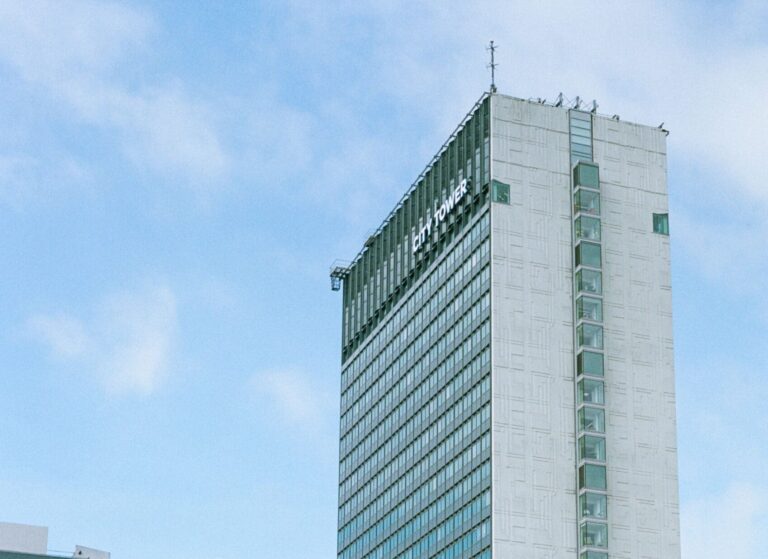
Manchester’s iconic City Tower has rebranded to celebrating its historic significance.

With a new motto of ‘Backing the bold’, the process, commissioned by the team of Schroders Capital on behalf of its owners and undertaken by OBI, aimed to revive one of Manchester’s tallest skyscrapers.

Built between 1959 and 1965, City Tower, formerly Sunley House, has been a familiar constant in the city’s ever-evolving urban landscape.

Its bold concrete façade is celebrated in the building’s new branding, with icons that reflect the digital technology and circuit-board-esque design on the North East and South West elevations, as well as the gridwork style reminiscent of its block structure.

OBI has designed a bespoke typeface for City Tower to evoke a sense of height, which works alongside a colour palette that respectfully reflects the period the building was designed, complete with a mixture of 1960s tones of British racing green, dusty red, grey, and black.

Big and bold

Alister Shapley, lead designer at OBI Property, said: “City Tower is the epitome of big and bold. Its unapologetic, brutalist aesthetic has stood proudly at the centre of Manchester for almost 60 years and we wanted to celebrate its forward-thinking design with the rebrand.

“The style is bold, eye-catching and modernist and the logo identifiers shift and reform like the building façade, whilst the numerous sub-brands align, but also provide room for slight distinction.

“The photography reflects City Towers’ tenants and features diversity across all genders, ages and ethnicities. They have been captured using striking angles, in dynamic compositions and have a fashionable finish.”

A phased replacement of all existing branding is underway, with more than 900 pieces of signage, icons and wayfinding being updated in the process. A new website is being developed, too, alongside rebranding City Towers’ social channels.

Rebranding process

Rob Prescott, asset manager at Schroders Capital, added: “Schroders Capital is proud to manage this landmark asset situated at the Centre of Manchester and refresh the branding of this landmark asset at the Centre of Manchester, to better reflect the asset and its unique characteristics.

“City Tower offers the best of both worlds – a modern workspace with an historically-significant exterior which, combined with unrivalled high-rise views of the city, stands out amongst the competition.

“With its unique blend of occupiers from various industries, City Tower has become a thriving hub of collaboration and innovation. The Tower’s vibrant mix of professionals brings together a wealth of expertise, fostering a lively and stimulating environment that encourages creativity and growth.

“In order to reflect the vibrant diversity within the building and highlight its bold aesthetic, City Tower has undergone a comprehensive rebranding process. The new branding embodies the essence of the tower’s dynamic atmosphere, capturing its energy and forward-thinking approach.

“This is just the start of a busy period at the building and we’ll continue to communicate on its transition over the next months.”