Home Blog Page 17

Scott “Matchmaker” Michaels: Turning Overlooked Ideas Into Hair, Football and Los Angeles Opportunities

0

Scott “Matchmaker” Michaels has spent much of his career looking in places where others may not see obvious commercial potential. From his beginnings as a hairdresser in Lancashire and the creation of Hairbond, through the revival of Stylo Matchmakers and his latest attempt to bring the Los Angeles Aztecs back into the spotlight, Michaels has repeatedly pursued the same principle: identify value that has been overlooked, connect the right pieces and see whether it can be turned into something commercially real.

Michaels did not start out with an investment thesis. His early career was spent behind the chair in Lancashire.

Originally from Morecambe, Michaels worked as a stylist before operating The Cutting Room in Lancaster. Working with professional products every day gave him an opportunity to notice something that larger consumer companies often spend heavily trying to understand. Customers would see their finished haircut and frequently ask what product had been used.

For Michaels, those questions represented more than casual curiosity. They were direct evidence that a product was creating an effect customers wanted to understand and potentially replicate.

In 2008, that observation helped lead to the creation of Hairbond.

Building Hairbond From the Salon Out

Michaels positioned the British styling brand around professional hairdressers and barbers instead of relying primarily on supermarket distribution. The thinking was simple: if professionals trusted a product and used it successfully with clients, that credibility could provide a stronger foundation for consumer demand.

The timing proved significant. Men’s hair and personal care were undergoing a period of rapid change. By 2025, Euromonitor estimated the broader UK men’s grooming market, including fragrances, shaving and toiletries, at £2.3 billion, representing 6% value growth in one year. Hair styling is only part of that market, but Hairbond had entered the sector years earlier as men’s grooming was moving beyond inexpensive supermarket gels towards clays, waxes, pomades and professional formulations.

Hairbond says it has since sold millions of products internationally. The business expanded well beyond Lancashire, with established overseas relationships including more than a decade of distribution in the Netherlands and sales in markets such as the United States.

Sport became another important part of the brand’s development.

Professional footballers and other athletes used and promoted Hairbond, helping strengthen its links with football culture. England cricketer Jimmy Anderson became an ambassador, while footballers and professional stylists helped introduce the products to dressing rooms, barbershops and entertainment circles.

Michaels’ position has remained consistent: celebrity may attract attention, but sustained sales ultimately depend on whether the product delivers.

That philosophy is relevant again as Hairbond prepares its first major styling-product expansion in five years.

Drifter Professional Hair Crème, Forger Putty and Vector Hair Gum took around two years to develop. Each has been created for a different styling requirement rather than simply presenting variations of one formula.

Drifter is designed for softer control, movement and natural texture, including longer and curlier hair. Forger offers stronger hold, matte texture and structure without the extremely dry finish associated with many contemporary clays. Vector takes a different approach, providing glide, separation and natural shine for longer or more polished styles.

The formulations are paraben-free and sulphate-free, with a UK supplier responsible for filling and final production. That allows Hairbond to describe the products in those terms, although broader claims around being completely British manufactured would require the entire supply chain to support them.

There is another, less visible side to maintaining a product portfolio.

Independent brands cannot always leave successful formulas untouched. Ingredients become unavailable, suppliers change and minimum production requirements move. Hairbond has previously replaced products when important raw materials could no longer be sourced rather than reducing the formula’s quality while keeping the same product name.

That is part of the reality of long-term brand building. Success involves balancing product performance, manufacturing constraints and commercial sustainability over time.

The Football Brand That Lost Its Place

By 2017, Michaels had turned his attention towards another form of overlooked value: football heritage.

Football had become increasingly wealthy, international and commercial, yet numerous historic British sporting brands had disappeared while a relatively small group of global manufacturers gained increasing control of the market.

One name caught his attention.

Stylo Matchmakers.

Stylo had been connected with some of football’s most recognisable figures, including Pelé, George Best, Kevin Keegan, Billy Bremner, Bobby Moore and Denis Law.

The George Best connection was especially powerful.

Best had become a football celebrity long before modern personal branding had developed into the sophisticated industry it is today. At Manchester United, he occupied the worlds of football, fashion, nightlife and celebrity at the same time. Stylo was not simply borrowing his image decades later. Best genuinely wore the company’s boots and appeared in its advertising.

Then Stylo disappeared from mainstream football.

For Michaels, the obvious question was why a British sporting name with such a strong association with players of that calibre had lost its commercial relevance.

In 2017, he became involved in bringing Stylo Matchmakers back.

Rather than treating the brand purely as a retro clothing opportunity, Michaels took a more demanding approach. If Stylo was going to return as a football brand, it needed to make football boots.

That meant dealing with factories, samples, tooling, soleplates, materials, packaging, trademarks, inventory and distribution. The reality was considerably more complicated than simply placing an archive image of George Best on social media.

The revived Heirship range offered several approaches to the modern football boot. The Heirship Seventeen used microfibre, the Sixty Eight used leather while drawing deliberately on the Best era, and the Seventy Four moved towards a softer premium-leather construction.

The pricing was also intended to sit well below the top end of today’s elite football boot market.

The Heirship Seventeen initially retailed at £129, the Seventy Four at £109 and the Sixty Eight at £99. Stylo subsequently moved the range to a £59 direct-to-consumer price, while premium boots from major manufacturers can now cost more than £200.

Professional footballers returned to Stylo, and Michaels says the revival sold more than 10,000 pairs.

That sales figure helped illustrate an important distinction.

Nostalgia can make people pay attention.

A product that works gives them a reason to purchase.

When Football Became the Matchmaking Business

Michaels’ involvement in football eventually expanded beyond products.

He became an FA-registered football intermediary, working with players, clubs, agents and transfer opportunities.

At one point, he says he held mandates covering more than $100 million in football talent, as well as club-side mandates involving Boavista and Central Coast Mariners.

The experience changed the way he viewed value.

Supporters generally see the final stage of a transfer. A player signs, photographs are taken, the fee is reported and the transaction appears complete.

Behind that moment can be months of discussions involving agents, recruitment teams, managers, owners, families, budgets, work permits, competing clubs and timing.

Having a good player does not guarantee a deal.

Having a club with a need does not guarantee one either.

A transaction only happens when enough of the individual pieces come together.

That is where the name “Matchmaker” became more than a nickname.

Michaels increasingly identified the same pattern across different areas. Value can exist without being realised simply because the right people, rights, capital or opportunities have not yet been connected.

Players were one example.

Brands were another.

Football clubs could potentially become another.

From George Best to Los Angeles

That thinking now sits behind Michaels’ most ambitious project: the attempted revival of the Los Angeles Aztecs.

The original NASL club featured Johan Cruyff and George Best, creating a remarkable historical connection between the Stylo story and Michaels’ current work in California.

The present project is not yet an operating professional football club, and that distinction is important.

Its Wefunder campaign currently shows $8,850 towards a $50,000 target. The stated investment structure uses future equity with a $2 million valuation cap, while the first $100,000 is offered under early-bird terms at a $1.5 million cap. The campaign identifies a first event in 2027 and outlines a longer-term ambition of reaching $5 million in annual revenue.

Those numbers provide a clearer sense of the opportunity.

They also underline how early the project remains.

The Aztecs have not publicly committed to a final professional league pathway. Crowdfunding does not guarantee a league place. Owning or controlling a historic trademark does not provide a stadium. A famous former player does not automatically create a modern supporter base.

Los Angeles is also one of the most competitive sports markets in the country.

MLS now has 30 clubs, including LA Galaxy and LAFC. MLS NEXT Pro also has 30 teams in 2026, while USL is developing its own interconnected professional structure through its new Division One competition, USL Premier.

Any professional route would also operate within a regulated framework. U.S. Soccer certifies professional leagues against standards covering ownership strength, stadiums, market coverage, staffing and financial viability. Its policy framework requires men’s outdoor professional leagues to have at least eight certified professional teams.

History, therefore, cannot replace infrastructure.

That is the central challenge facing the Aztecs project.

The potential benefit of heritage is not that it removes the difficult work. It may instead reduce one of the most expensive challenges in sport: building an identity and emotional connection from zero.

New sports properties can spend heavily attempting to create awareness, mythology and loyalty. A historic property may already possess some of those ingredients, provided there are enough people who still care.

That is the wager.

From Products to Assets

Viewed separately, Michaels’ career can appear to span a surprising number of industries.

Hair styling.

Football boots.

Player mandates.

Dormant sporting intellectual property.

Crowdfunding.

Football ownership.

Writing.

Today, those strands come together through ScottMatchmaker.co.uk, which serves as a central platform for his work across football, brands, ownership and ideas.

The underlying argument is more consistent than the individual industries might suggest.

Hairbond gave Michaels a lesson in recognising unmet demand.

Stylo demonstrated that forgotten history can still contain commercial potential.

Football agency showed him that value only becomes meaningful when interests can be brought into alignment.

The Los Angeles Aztecs represent an attempt to apply those lessons to a considerably larger asset.

There is also an important difference between Hairbond and the heritage projects.

Hairbond was not revived.

It was built.

That gives Michaels’ philosophy two distinct sides.

Sometimes entrepreneurship means recognising something valuable that others have stopped paying attention to.

Sometimes it means seeing the potential in something that does not yet exist and attempting to create it.

Both approaches require judgement.

Neither guarantees the outcome.

Some dormant brands disappear for good reasons. Some negotiations never reach completion. Some audiences have no interest in heritage. Some ambitious projects remain just that: ambitious projects.

That uncertainty is why evidence matters.

Hairbond has nearly two decades of trading behind it and says millions of products have been sold. Stylo returned a dormant football name to manufacturing and sold more than 10,000 pairs of boots. The Los Angeles Aztecs, in contrast, remain at the venture stage, with its most significant milestones still to come.

That progression is more credible than presenting every project as an established success.

From a hairdressing chair in Lancashire to George Best’s football boots and a crowdfunded football proposition in Los Angeles, Michaels’ career has increasingly centred on one question:

Where is the value that the existing system has failed to recognise, connect or develop?

His answer is reflected in the philosophy behind the name.

Find the value.

Understand why it matters.

Connect the pieces.

Then try to turn the idea into something real.

More on Scott “Matchmaker” Michaels, his businesses, football projects and writing can be found at ScottMatchmaker.co.uk.

Bristol roofers warn: “wear and tear” is costing homeowners their storm damage payouts

0

BRISTOL, UK. 1 September 2026 – Bristol homeowners have roughly eight weeks to deal with small roof faults cheaply, according to a local roofing firm, and most will miss the window.

Bristol Roofing Pros says the same handful of minor problems come back every autumn, and that the difference between fixing them in September and discovering them in January is measured in thousands of pounds rather than hundreds.

The firm publishes its repair prices openly. A leak investigation runs £80 to £200. Two or three slipped slates cost £100 to £300 to put back. Repointing crumbling mortar around a chimney flashing, one of the most common faults on a Bristol semi, is £150 to £350. Left through a wet winter, the same faults let water into roof timbers and ceilings, and the repair stops being a repair. A full re-roof on a typical Bristol terrace starts around £5,000.

“Nobody rings a roofer in September, because in September nothing is leaking,” said Charlie of Bristol Roofing Pros. “They ring in January, when it’s dark at four o’clock, everyone’s booked up, and the cheap version of the job stopped being available about eight weeks ago. The work itself hasn’t got harder. It’s just that the water has been in there since November.”

Bristol’s climate makes the city harder on roofs than much of the country. The city takes over 800mm of rain a year and stays mild and humid, close to ideal conditions for moss and algae. North-facing slopes that never dry out are worst affected, and the leafier suburbs, Bishopston, Redland and Stoke Bishop among them, collect extra shade and leaf debris from mature trees. Moss holds water against the tiles and blocks the gutters it eventually washes into.

The firm’s autumn advice is unglamorous and mostly free. Clear the gutters and downpipes before the leaves finish falling, because a blocked outlet pushes water back under the roofline where it does damage nobody sees for months. Look along the ridge from the pavement for gaps in the mortar. Check the roof after any windy night for slates that have moved, particularly on exposed ground on the western side of the city. And go up into the loft on a bright day, because daylight coming through, or a damp patch on a rafter, will show up there long before a stain appears on a bedroom ceiling.

Winter also costs more in a way homeowners rarely factor in. Same-day emergency call-outs run £150 to £400 on top of whatever the repair itself costs, and by midwinter the good contractors are working through a backlog, so the wait is longer as well as the bill.

“A roof gives you plenty of notice,” Charlie added. “It just gives it quietly, in September, in ways you have to actually go and look for. Ten minutes with a ladder and a torch in the loft is worth more than any amount of worrying about it in February.”

Bristol Roofing Pros carries out roof repairs in Bristol and across Bath, Portishead, Clevedon, Weston-super-Mare and the surrounding areas. Assessments are free and every job is quoted in writing before work starts.

Cyber security on an SME budget: What actually makes a difference

0

Whenever cybersecurity guidelines and protocols are mentioned, you know they’re targeted
at businesses with enterprise-level budgets.

The companies with dedicated teams and specialist tools that SMEs can only dream of. It’s not only unattainable, it’s unrealistic, and smaller companies know this, which tends to lead to inertia. But that doesn’t have to be the case.

The reality is that SMEs don’t need to do everything. The six-figure tooling and complex
governance frameworks, they’re irrelevant. What they actually need is to implement a small
number of well-implemented controls, and ensure that they’re adhered to consistently.

The small set of security measures that support SMEs the most

Most cyber security breaches that impact SMEs don’t come down to deliberately targeted
attacks inspired by any particular grievance, but rather opportunity. And those opportunities
come because simple security processes are overlooked. From weak passwords and
unpatched systems, to phishing emails and poor backups. Fixing these issues can
significantly reduce the security threats faced by SMEs.

Multi-factor authentication (MFA) is one of the most effective measures that most SMEs
can deploy when seeking to improve cybersecurity. But it needs to be applied consistently
across platforms, and have protocols put in place to ensure regular password updates.
Compromised login details remain the primary entry point for cyber attackers.

In fact, nearly 68% of confirmed breaches in the 2025 Verizon Data Breach Investigations Report (DBIR) were linked to a surge in stolen usernames and passwords. When you implement MFA, and combine it with role related access, it becomes harder for those breaches to happen.

Patch management is another high-risk area. Unless you have a dedicated IT team, it’s
easy to fall behind on software updates and fixes. And that’s what attackers target. When
you take steps to ensure that operating systems, applications, firewalls, and network devices
are kept up to date, you make it considerably harder for unauthorised access to take place.

Then there’s the matter regular system and data backups. System and data backups
support resilience better than almost anything else.

There were an estimated 7,400 recorded ransomware attacks globally in 2025. But they’re only successful when a company has no way of restoring the stolen data. When you have automated backup systems, protected from tampering, these attacks become far easier to recover from.

The last problem relates to people. You don’t need your entire team to become security
experts, but they should have basic knowledge. How to spot phishing attempts, why
password reuse is dangerous, and how to report suspicious activity. When you train your
team, you build your first line of defence.

These are all simple things that businesses can do to improve their security, but SMEs
continue to waste money without generating noticeable security improvements.

Where SMEs commonly overspend on security

The problem with cybersecurity is that it’s drummed into every business that they have to
spend a lot of money to protect their assets. So, many SMEs end up investing in areas that
provide little real protection.

One common mistake is purchasing advanced security tools without the capacity to manage them. While SIEM systems and complex monitoring tools can work incredibly well, if you don’t have the skilled staff to work with them, they can easily become an expensive annoyance.

There’s also an over-reliance on perimeter security, such as firewalls and secure gateways.
These do matter, and they do have a place, but they don’t do everything. Even the most
expensive tools won’t protect your cloud services, email, or remote workers if you’re not
taking steps to protect access.

Many businesses also come unstuck through a reliance on one-hit security. They invest in
high-end products, but fail to introduce sustainable practices or stay on top of updates.
Cybersecurity must be an ongoing priority, simply because cybercrime is constantly
evolving.

So, what needs to be the focus for SMEs?

The small set of controls that matter most. When you have limited funds available, you always have to prioritise, so start with the question: what would cause the most damage if it failed?

For most businesses, that includes email, core systems, customer data, and the ability to operate day-to-day. And that gives you your list of priorities.

From there, you can work on incremental improvements:
● Start by securing access. That means introducing MFA, strengthening passwords,
and removing unnecessary admin rights.
● Then reduce risk. So, patch systems, remove unused accounts, and simplify
processes where possible.
● The next step is to introduce a business continuity plan. This means ensuring
backups work, incidents can be detected, and your teams understand what they
need to do.
● Work on iteration. When you embed simple processes that can be maintained, you
build security into your company’s core.

Cybersecurity for SMEs is entirely different to enterprise level infrastructure. It has to be. But
when you understand the common threats, and implement simple but consistent and
cohesive controls, you can protect your company without overstretching your budget,
building resilience as you go.

William Thackray, Operations Director, of Manchester based AGT Computer Services

Cheshire firm recognised for WellChild support

Ultra Decking has been recognised for its long-standing support of children’s charity WellChild, having helped transform gardens for more than 1,000 seriously ill children.

Since the partnership began, the Cheshire company has supported more than 50 projects through WellChild’s Helping Hands programme, donating over 1,500 decking boards and improving outdoor spaces for over 1,000 children and their families.

Helping Hands brings teams of volunteers together with families caring for seriously ill children, adapting homes and gardens to create safe, accessible spaces where children can play, relax and spend time outdoors.

Ultra Decking’s composite decking has played a key role in many of those projects. The boards are durable and low-maintenance, and they create the smooth, level surfaces that matter in gardens used by wheelchair users and children with mobility challenges..

Kieran Cullen, Helping Hands Programme Manager at WellChild, said: “Ultra Decking’s support over the past few years has been invaluable. Without their generosity, many of the life-changing garden transformations we deliver through Helping Hands would have become prohibitively expensive.

“Their composite decking is ideal for the families we support, creating safe and accessible outdoor spaces where children who rely on wheelchairs can enjoy their gardens like never before. This partnership is a fantastic example of the real impact a company can make.”

Allan Jeffrey, CEO and managing director at Ultra Decking, said: “WellChild’s ‘Helping Hands’ projects align perfectly with our own expertise. Many of the families they support are unable to use their gardens due to accessibility issues or the high maintenance required.

“By supporting WellChild, we are helping to create low-maintenance, splinter-free, and wheelchair-friendly sanctuaries that allow children with complex medical needs to play and thrive safely at home. We believe every child deserves a garden that is a place of joy rather than a barrier, and we are proud to contribute to a charity that makes that possible.”

Cyber security “no longer an optional consideration” say Lancashire Police

0

As a business owner, no matter if you are a large corporation, a small enterprise, or a one-person trader, you are a target for cyber criminals.

We see the headlines of huge, multi-national businesses being attacked and get the sense that criminals are only interested in them.

In reality, cyber criminals don’t care about the size of a company or how big they are. They look for the weaknesses, and if your online defences are poor, you could be exposed and this will have devastating consequences for your business.

Recent government figures show that a significant cyber-attack, for an individual business, will cost them almost £195,000. When we scale this to a full UK Cost, it reaches an estimated cost of £14.7 billion.

The message from the government, the National Cyber Security Centre (NCSC) and Lancashire Police is loud and clear, cyber security is no longer an optional consideration for your business. You must take responsibility to improve your online safety and protect your assets as best you can.

Therefore, to help businesses of all sizes in Lancashire stay ‘cyber safe’, Lancashire police have compiled a list of options that will assist businesses improve their cyber security and better protect their systems, data and customers.

Cyber Essentials

This is a government backed programme for businesses to follow that sets out the minimum standard of cyber security recommended for organisations of all sizes. It is designed to prevent the most common internet based cyber security threats as, contrary to opinion, most cyber attacks are basic in nature.

Think of these simple cyber-attacks as the online equivalent of a burglar trying the front door handle to see if it is unlocked. Having Cyber Essentials helps ensure this digital door is shut
and secure, keeping your digital data and information safe.

Cyber Action Toolkit

The NCSC has developed this free online tool that help businesses work through Cyber security controls step by step and in their own time.

 Free to use
 Quick to start
 Actions to complete at your own pace
 Build layers of protection around your business.

Northwest Cyber Resilience Centre

This home office funded resource is a police-led partnership that provides SMEs with professional cyber security services and protection. They offer services such as staff training, network and website vulnerability assessments and digital footprint assessments.

SMEs simply need to sign up on the CRC website and take advantage of the fully funded options that are available.

Government Cyber Resilience Pledge

The government has created this voluntary Cyber Resilience Pledge, which provides organisations a chance to demonstrate their commitment to cyber security, increase their resilience to online threats and stand out from their competitors.

Those signing up are asked to commit to the following actions:
 Make cyber a Board responsibility
 Sign up to the Early Warning service
 Require Cyber Essentials across their supply chains.

Organisations would also commit to encouraging these actions across their supply
chains and publishing the signed declaration on their websites.

For more information, visit: https://www.nwcrc.co.uk/

UK Summer Travel Guide: Choose the Right BLUETTI Power Solution

Recent heatwaves across Europe are making reliable off-grid power more important than ever for summer travel. Whether you’re travelling by campervan, RV or camping off-grid, the right portable power station helps keep fridges, fans and essential devices running throughout your journey.

This guide explains how to choose the right BLUETTI portable power solution for your travel style, with a quick comparison of the best power stations and RV power systems for weekend camping, van life and long motorhome trips.

Screenshot 2026 08 30 195707

Tips on Buying a Power Station for Summer Travel

Estimate Your Energy Needs

Start by listing your essential appliances and estimating your daily energy consumption. Weekend trips usually require less capacity, while longer journeys with fridges, cooking appliances and additional devices need more storage.

Consider Your Charging Options

For longer journeys, don’t rely only on campsite electricity. Choose a power solution that supports multiple charging methods, such as solar, vehicle charging and AC input, to keep your batteries topped up wherever you go. Choosing a BLUETTI Power Solution for Your Travel

Weekend Escapes (3–7 Days)

If you’re travelling in a compact SUV, estate car or micro camper, a portable power station provides reliable off-grid power without taking up too much storage space or draining your vehicle’s starter battery. Typical energy needs include a 12V fridge, kettle, fan, laptop and mobile devices, requiring around 1–2kWh per day, or up to 2.5kWh with regular electric cooking.

Recommended Setup: BLUETTI Elite 300 + PV350 Solar Panel
With 3,014Wh capacity and 2,400W output, the Elite 300 is designed for everyday camping
essentials while remaining compact enough for smaller camper setups. Paired with the PV350 solar panel, it provides quiet, renewable charging—an ideal solution for campsites where fuel generators are restricted.

Screenshot 2026 08 30 195559

Extended Road Trips & Van Life (1–3 Weeks)

Weeks of van travel often mean moving between campsites, scenic stops and remote locations. A flexible power system with fast recharging capability helps you stay powered wherever your journey takes you. Longer trips typically involve higher energy demands, with larger fridges, cooking appliances, cameras, drones and e-bike charging increasing daily consumption to around 2.5–4kWh. This can rise further when using high-power devices such as portable air conditioners.

Recommended Setup: BLUETTI Apex 300 + B300K / B500K + Charger 2 + DC Hub
The Apex 300 provides a flexible foundation for extended off-grid travel, while additional batteries increase available capacity. The Apex 300 + B300K offers 5,529.6Wh of storage, while the Apex 300 + B500K expands capacity to 7,884.8Wh.

When driving to the next destination, Charger 2 enables faster recharging by combining alternator and solar input, while the DC Hub integrates the system with the van’s 12V electrical setup.

Screenshot 2026 08 30 195422

Which Off-Grid Power Solution Is Right for You?

BLUETTI Solutions Power / Capacity Ideal Travel Suited Vehicle Type
Elite 300 Solar Kit 2.400W / 3.014Wh 3–7 Days Compact SUVs, micro camper
Apex 300 Charger 2 Kit 3.840W/2.764,8Wh+ 1–3 Weeks Campervans, pop-top camper

Conclusion

Choosing the right off-grid power system depends on your travel style and energy needs. Compact power stations are ideal for short trips, while longer journeys benefit from expandable storage and flexible charging options. With the right BLUETTI solution, travellers can spend less time looking for electrical hook-ups and more time exploring Europe’s roads, campsites

Van Haven Reveals New T7 showcase and Limited-Production Supervan at Haynes Motor Museum

0

YEOVIL, UK. August 27th, 2026 – Volkswagen Transporter conversion specialists Van Haven are unveiling their new T7 range at the Haynes Motor Museum this weekend.

The range will be unveiled to invited guests and media at Haynes Motor Museum on 28 August before opening to customers and the public on 29–30 August, with motorsport engineering firm RML Group as headline sponsor.

Each vehicle requires around 120 hours of specialist work at Van Haven’s Shillingstone workshop. The line-up is as follows:

T7 Camper — The Hambledon: The conversion Van Haven built its name on, now on the new T7 platform. It features 62mm of insulation fitted by hand, stitched leather, colour-matched panels and the manufacturer’s warranty left intact.

T7 Sports — VH-PMV: The performance take on the platform, making its debut alongside the Camper.

T7 Swamper — VH-X: In development for next year, built for owners who want a T7 that can leave the road.

Parked beside them will be a £20 million line-up of Koenigsegg hypercars from Van Haven’s exhibiting partner, SuperVettura.

Alongside the T7 launch, Van Haven is also revealing a limited-production Supervan featuring the engine from an Audi RS3.

“Supervans have traditionally been one-offs, built once and never repeated,” said Paul Kilbride, Managing Director of Van Haven.

“Putting one into limited production means a customer can order one, and that’s the point. The engine will get the attention, but repeatability is the real breakthrough.

“This is a Van Haven programme from the first sketch to the finished vehicle: our concept, our production line and our name on every one that leaves it.

“At its core are two donors: a VW Transporter T6.1 and an Audi RS3, complete with its 2.5-litre five-cylinder turbo engine. Both were chosen deliberately, not by chance, as the starting point for an ambitious limited-production engineering programme.”

For the engineering, Van Haven has partnered with RML Group – a Wellingborough-based engineering company founded by racer and engineer Ray Mallock in 1984. Four decades on, the company has built a reputation as one of the most capable technical operations in British motorsport and automotive engineering.

RML counts Aston Martin, McLaren Automotive, Bentley, Nissan, Lotus Cars and NIO among the manufacturers it has worked with on special projects, holds the contract as Official Parts Supplier to the British Touring Car Championship, and its own build sheet includes the McLaren Senna GTR, continuation Bizzarrini 5300 GTs, the Nissan Juke-R and its own RML Short Wheelbase and GT Hypercar programmes.

Paul Kilbridge added: “Backed by fresh investment and a new leadership team as it enters its fifth decade, RML is exactly the kind of partner capable of taking on a programme of this ambition.

“We’re not detailing the engineering itself. It’s the part of this project we’re proudest of, and the full story will be told closer to launch.”

RML is running the Supervan through the same formal, gateway-based development process it uses on full OEM production programmes, such as benchmarking, simulation, prototype build and validation, with a route to type approval already being mapped out alongside UK homologation specialists. Every prototype is being rigorously tested, on track and on the road, before a single one reaches a customer.

James Nurse, Principal Engineer at RML Group, added: “Van Haven brought us a problem nobody in this industry has solved: how to make something as extreme as a Supervan repeatable, safe and homologated, without losing what makes it special. That’s a serious engineering challenge, and exactly the kind of project RML exists for.”

The Supervan is in development now and arrives next year, strictly limited to 30 examples, with customer ordering details to be announced in due course.

The invitation-only VIP day on Friday 28 August will close with a private dinner for 120 invited guests, a toast to Van Haven’s first ten years and a live set by Rick Parfitt Jnr & The RPJ Band to see the night out.

A documentary telling the full story of the event will follow in September.

UK health tech firm receives The King’s Award for Enterprise in Innovation

0
A leading UK medical technology company has been recognised for Molto, its innovative device designed to support prostate care and pelvic wellness
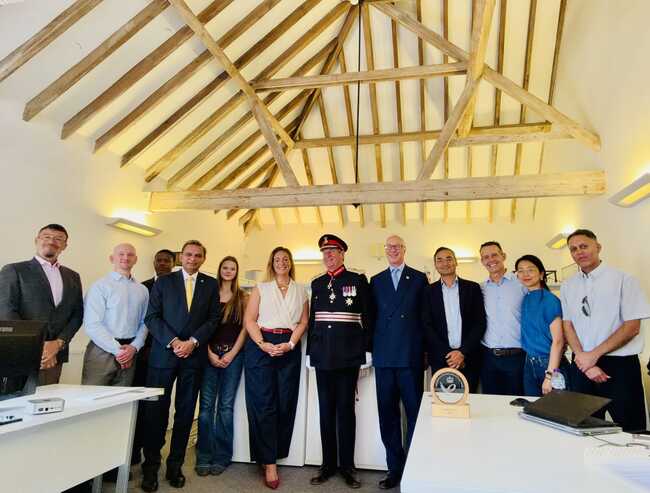
MV.Health has received The King’s Award for Enterprise in Innovation in recognition of its development of Molto, an ultra-slim, flexible medical device designed to provide targeted support for prostate care and pelvic wellness.

The award recognises the company’s work developing doctor-designed medical devices for urological, gynaecological and sexual health, with a particular focus on giving patients more private and accessible ways to manage aspects of their intimate health at home.

Just 52 Innovation awards were made across the UK in 2026. This year also marks the 60th anniversary of The King’s Awards for Enterprise, which were first awarded in 1966.

Molto was developed following years of engineering and peer-reviewed clinical research into conditions including chronic prostatitis and ejaculatory dysfunction.
MV.Health says embarrassment, stigma and hesitation can prevent some men from seeking support for urological concerns, despite these conditions affecting millions of people.

Molto was designed as a non-pharmacological option that can be used at home alongside appropriate advice and care from medical professionals.

Dr Soum Rakshit, co-founder and chief executive of MV.Health, said:

“Receiving The King’s Award for Enterprise at our offices was an incredibly proud moment for our entire team. Molto is the result of years of engineering and peer-reviewed clinical research into conditions like chronic prostatitis and ejaculatory dysfunction – problems that affect millions of men yet are rarely spoken about. This award recognises that work, but more importantly it recognises prostate health itself. We are honoured to play a part in bringing it into the mainstream, with the visibility it has long deserved.”

Founded in 2014, MV.Health develops doctor-designed medical devices for urological, gynaecological and sexual health.

Its work covers health concerns including chronic prostatitis, delayed ejaculation, erectile dysfunction, arousal disorder, vaginal dryness and pelvic pain.
The company focuses on creating devices that allow patients to manage aspects of their intimate health privately at home, while continuing to seek clinical care where necessary.

MV.Health says its devices have received more than 60 awards and have supported more than 250,000 patients around the world.

The King’s Award for Enterprise in Innovation recognises the development of Molto and the company’s wider commitment to creating medical technology in areas of health that are often overlooked or difficult to discuss.

His Majesty’s Lord-Lieutenant for Surrey, Michael More-Molyneux, formally presented the award on behalf of His Majesty The King at MV.Health’s premises at Shoelands Farm Offices in Puttenham on Wednesday 26 August.

The presentation included a tour of the company’s premises, where invited guests were shown the work, facilities and projects behind MV.Health’s medical devices.
The King’s Awards for Enterprise recognise outstanding achievements by UK businesses in the fields of innovation, international trade, sustainable development and promoting opportunity through social mobility.

Winners are presented with their award at their company by a Lord-Lieutenant, one of The King’s representatives, and are also invited to a Royal reception. The award allows recipients to use The King’s Awards emblem for five years.

For MV.Health, the recognition marks another milestone in its work to develop innovative technology for intimate health and to bring conditions such as prostate health, pelvic pain and sexual dysfunction into wider public conversation.

Searches for Automotive Jobs Surge 28% as UK’s Unexpected New Motor Industry Hotspots Revealed

0
New analysis finds Guildford, Exeter and Dartford are outperforming major cities for motor industry job opportunities as searches for automotive careers climb
Britons are increasingly looking for careers in the motor industry, but new research suggests some of the best opportunities are emerging far away from the UK’s traditional automotive hotspots.

Searches for “automotive jobs” have risen 28% over the past year, reaching 19,000 searches in the past month, according to Google search data analysed by Regtransfers .

Interest appears to be accelerating further, with searches for “mechanic jobs” jumping 45% in the past month alone, also reaching 19,000 monthly searches.

Now, new research from private number plate specialist Regtransfers has revealed where that growing number of jobseekers could have the best chance of finding work.

Analysis of automotive businesses and job vacancies across 96 UK towns and cities found that Guildford, Exeter and Dartford are emerging as three of the country’s strongest motor industry employment hotspots, beating much larger cities including Manchester and Birmingham.

Guildford Named UK’s Top Motor Industry Job Hotspot
Guildford topped the ranking after recording 2.5 automotive vacancies for every existing automotive business over the past 12 months.
That’s 2.8 times the national average, making the Surrey town one of the clearest examples of automotive employment opportunities appearing outside the places traditionally associated with Britain’s motor industry.

Exeter ranked second, with 387 automotive businesses supporting 602 vacancies over the past year and an overall job vacancy rate of 34%, among the highest recorded in the research.

Dartford placed third, where 259 automotive businesses generated 399 vacancies during the same period.

The findings suggest the geography of automotive employment could be broader than jobseekers might assume.

Despite Birmingham and Manchester having some of the largest automotive business bases in the country, their vacancy-to-business ratios were roughly six times lower than Guildford’s.

It means simply living near a major automotive centre does not necessarily translate into more opportunities for people currently looking to enter the industry.

The findings come as interest in automotive careers appears to be rising significantly.

Search demand for “automotive jobs” remained relatively stable for several years before beginning to climb more sharply through 2025 and 2026, with searches now 28% higher than a year ago.

Searches for “mechanic jobs” have also recently surged, increasing 45% in the space of a month.
The rise comes during a period of significant change for Britain’s automotive workforce, as electrification, EV infrastructure and new technologies create roles extending beyond traditional vehicle maintenance.

The government is also rolling out its £1.5 billion Youth Guarantee, including new Foundation Apprenticeships launching this year. One of the routes covers electric vehicle charging point installation and maintenance, creating another potential entry point into the wider automotive industry for younger workers.

Mark Trimbee, CEO of Regtransfers, said:
“There’s a perception that if you want to build a career in the motor industry, you need to look towards the places traditionally associated with automotive businesses and manufacturing.
What’s interesting about this research is that some of the strongest hiring activity isn’t necessarily happening in those places.
Guildford, Exeter and Dartford aren’t the first places most people would name if asked to identify Britain’s motor industry hotspots, yet they’re currently producing a significant number of opportunities relative to the size of their local automotive sectors.
At the same time, we’re seeing searches for automotive jobs rise considerably, suggesting more people are actively considering careers in the sector.
The industry itself is changing too. Working in the motor trade doesn’t necessarily mean being a mechanic. There are careers across sales, logistics, customer service, technology, administration and an expanding EV sector.
For anyone looking to enter the industry, particularly younger people considering their first career, the message from the data is to look beyond the obvious locations. Some of the strongest opportunities could be in places you wouldn’t expect.”
A New Map of Britain’s Motor Industry?
The research also raises questions about whether Britain’s traditional map of automotive employment is changing.

While cities such as Birmingham and Manchester retain large numbers of automotive businesses, the new ranking measures where businesses are actively recruiting relative to the size of the local industry.

That puts smaller and mid-sized locations much further up the table.

Further analysis of the 96 locations will examine whether there is a wider North-South divide in automotive employment opportunity, as well as which traditional motor industry centres are gaining and losing ground.

Why Leaders Should Stop Feeling Guilty About Taking a Summer Break

0

Leaders should not feel guilty about stepping away this summer, according to leadership expert Drew Povey, who says proper recovery is a key ingredient in maintaining strong performance throughout the rest of the year.

Drew Povey, author and founder of the Drew Povey Consultancy, has challenged five common misconceptions about summer holidays, arguing that taking time to properly recharge in July and August can help leaders return with the focus and energy needed to perform strongly through to Christmas.

Drew, who has more than twenty years’ experience working in elite level sport, education and business, says: “There are a lot of leaders I work with who carry a level of unnecessary guilt about taking time away, and others who feel like they need to rest in a certain way, as if it’s a rule.

“But actually, instead of seeing down time as slacking, we should be looking at it as an important part of working.

“What’s important to remember is that like most things in leadership, one size is never going to fit all. So the question isn’t whether you should switch off, it’s how you do it in a way that will genuinely help you perform when you return.

“There isn’t one perfect holiday strategy, but holidays are important. You’ve got to know yourself and make smart choices for you.

“The best leaders don’t copy someone else’s routine or style, they deliberately choose a recovery strategy that allows them to return with energy, better clarity, and better judgment.

“The goal isn’t simply taking time off in the summer, it’s coming back ready to lead well for those last four months.”

Here are Drew’s five holiday myths busted:

Good leaders don’t need a break

Everyone needs time away, Drew says. Some people even treat avoiding annual leave or getting by on too little sleep as a sign of dedication. This has helped create the idea that rest is somehow a weakness.

“The reality is that recovery isn’t a reward, it’s an essential part of performance,” Drew says. “Top athletes don’t get better during training, they improve during the recovery, and it’s the same in leadership.”

You need to completely switch off

How people use their downtime is a personal decision, Drew explains. Some prefer to leave their work phone and laptop behind, while others would find that more stressful and spend their holiday worrying about what they might be missing.

“If downing tools completely would create anxiety, then don’t do it,” Drew says. “Some people can enjoy their day as long as they’ve had ten minutes in the morning to check their emails, or know that someone can get hold of them if they’re needed. The trick is to communicate with your team and do what allows you to relax.”

You need at least a week off to relax

While some people prefer one substantial holiday, others recover more effectively through several shorter breaks, Drew says. A four-day break can provide plenty of recovery, meaning there is no need for people who dislike longer holidays to feel pressured into taking one. The important thing is finding a pattern that works personally.

Your holiday starts the moment you leave

“Holidays often start much earlier than when you shut down your computer,” Drew says. “You’re winding down for a few days before you’ve actually finished. The other side is that you need a few days to unwind before you can really start to relax.

“I fall into that group, which is why I’m the kind of person to take a ten-day break rather than several shorter ones. I need about three days to get into the holiday mood before I can properly switch off for a week.

“The trick is to communicate with your team and be realistic about what’s right for you.”

Summer is a time to completely ease off

July and August naturally have a different pace, and they can provide an excellent opportunity to rest and recharge, Drew says. However, leaders should avoid allowing a more relaxed summer to turn into an extended period of losing momentum.

“There’s no point coasting along if you’ve a busy September planned, because September isn’t built in September, it’s built in the habits we choose in July and August,” Drew says. “Rest will help us finish the last four months of the year strong, but we need to make sure we’re not stepping off too much or dropping our standards, because otherwise it will come back to bite us.”