
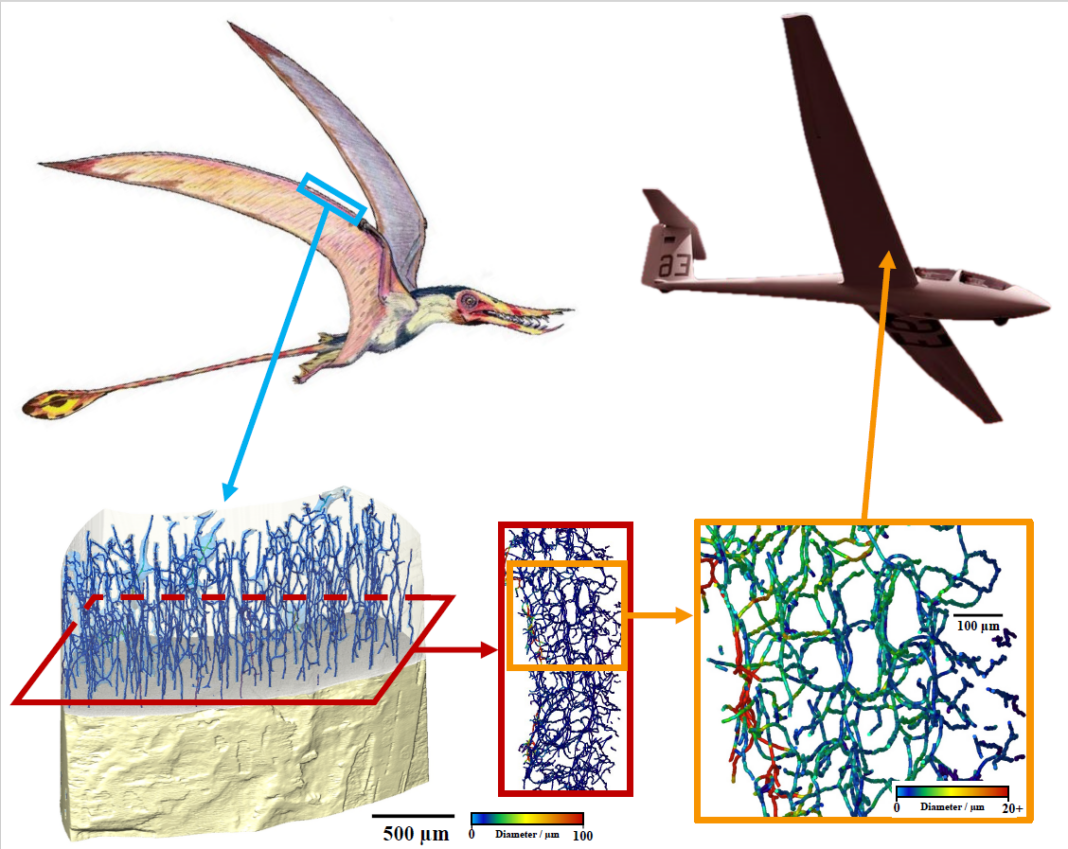
The microarchitecture of fossil pterosaur bones could hold the key to lighter, stronger materials for the next generation of aircraft, new research has found.
Scientists from The University of Manchester used advanced X-ray imaging techniques to examine fossilised bones of the prehistoric flying reptile at the smallest scale, revealing hidden engineering solutions right in the palm of their hands…or fingers to be precise.
They discovered that pterosaur bones contained a complex network of tiny canals, making them both lightweight and incredibly strong — details of its structure that have never been seen before.
Researchers say these ancient adaptations could have the potential to start a ‘palaeo-biomimetics’ revolution—using the biological designs of prehistoric creatures to develop new materials for the 21st century.
The findings are published today in Nature’s Scientific Reports.
The study’s lead author, Nathan Pili, a PhD student at The University of Manchester, said: “For centuries, engineers have looked to nature for inspiration— like how the burrs from plants led to the invention of Velcro. But we rarely look back to extinct species when seeking inspiration for new engineering developments—but we should.
“We are so excited to find and map these microscopic interlocking structures in pterosaur bones, we hope one day we can use them to reduce the weight of aircraft materials, thereby reducing fuel consumption and potentially making planes safer.”
The pterosaurs, close relatives of dinosaurs, were the first vertebrates to achieve powered flight. While early species typically had wingspans of about two metres, later pterosaurs evolved into enormous forms with wingspans reaching upwards of 10 metres. The size means they had to solve multiple engineering challenges to get their enormous wingspan airborne, not least supporting their long wing membrane predominantly from a single finger.
The team used state-of-the-art X-ray Computed Tomography (XCT) to scan the fossil bones at near sub-micrometre resolution, resolving complex structures approximately 20 times smaller than the width of a human hair. 3D mapping of internal structures permeating the wing bones of pterosaurs has never been achieved at these resolutions (~0.002 mm).
They found that the unique network of tiny canals and pores within pterosaur bones—once used for nutrient transfer, growth, and maintenance—also help protect against microfractures by deflecting cracks, serving both biological and mechanical functions.
By replicating these natural designs, engineers could not only create lightweight, strong components but could also incorporate sensors and self-healing materials, opening up new possibilities for more complex and efficient aircraft designs.
The team suggests that advancements in metal 3D printing could turn these ideas into reality.
Nathan Pilli said: “This is an incredible field of research, especially when working at the microscopic scale. Of all the species that have ever lived, most are extinct, though many died out due to rapid environmental changes rather than ‘poor design’. These findings are pushing our team to generate even higher-resolution scans of additional extinct species. Who knows what hidden solutions we might find!”
Professor Phil Manning, a senior author of the study from The University of Manchester, said: “There is over four billion years of experimental design that were a function of Darwinian natural selection. These natural solutions are beautifully reflected by the same iterative processes used by engineers to refine materials.
“It is highly likely that among the billions of permutations of life on Earth, unique engineering solutions have evolved but were lost to the sands of time. We hope to unlock the potential of ancient natural solutions to create new materials but also help build a more sustainable future. It is wonderful that life in the Jurassic might make flying in the 21st Century more efficient and safer.”
With the aerospace industry constantly striving for stronger, lighter, and more efficient materials, nature’s ancient flyers may hold the key to the future of flight. By looking back hundreds of millions of years, scientists and engineers may well be paving the way for the next generation of aviation technology.
Image credit: Nathan Pili