Home Blog Page 40

Thousands still dying from asbestos exposure decades after UK ban, research warns

More than 25 years after asbestos was banned in the UK, the material continues to cause around 5,000 deaths annually, according to new findings from Shield Services Group. Experts say the ongoing dangers linked to asbestos exposure are still not fully recognised.

  • 5,000 UK deaths every year are linked to asbestos. More than road traffic fatalities
  • 1.5 million buildings still contain asbestos, including around 80% of schools
  • The Health and Safety Executive reports 20+ tradespeople die each week from past exposure
With around 5,000 deaths annually, asbestos remains the leading cause of work-related fatalities in Great Britain, surpassing many other widely publicised health and safety risks. Despite this, the material remains widespread, embedded in an estimated 1.5 million buildings nationwide.

The danger is not confined to ageing industrial sites or large demolition projects. In reality, the greatest risk often lies in everyday environments – schools, offices, homes and in routine maintenance work where asbestos-containing materials are unknowingly disturbed.
Schools present one of the starkest examples. Around 80% of UK schools are believed to contain asbestos, raising ongoing concerns about long-term exposure risks for staff, contractors, and pupils.

Meanwhile, tradespeople continue to pay the price. According to the Health and Safety Executive, more than 20 workers every week die from diseases caused by past exposure.

For Shield Services Group, the data points to a critical issue: inconsistent standards across the industry, particularly when it comes to smaller-scale work.

Luke House, Chairman of Shield Services Group, said: “The numbers should be a wake-up call. Five thousand deaths a year isn’t a legacy issue as it’s happening right now.

“What’s most concerning is where the risk still exists. It’s not just on major demolition sites, it’s in everyday buildings and smaller jobs where asbestos is often overlooked or underestimated. That’s where people are being exposed.
“If the industry is serious about reducing these figures, we need to treat every job, no matter how small, with the same level of care, control, and accountability.”

Shield Services Group delivers asbestos removal across projects of all sizes, from single-property works to complex commercial sites, reflecting the reality that exposure risk does not discriminate by project scale.

Alongside this, the company is embedding social value into its operations, ensuring that asbestos removal also contributes to local employment, training, and community outcomes.

How to ensure successful transitions into new international markets

International expansion still appeals to ambitious businesses, but many companies
underestimate how quickly unfamiliar markets expose weak planning. A strategy that works
well in the UK may struggle overseas because customer expectations, regulations and
buying habits often differ more than leadership teams expect.

At the same time, global growth offers genuine opportunities when you approach it with strong research and realistic targets. Businesses that prepare properly often gain more stable revenue streams, stronger supplier networks and access to larger customer bases.

Choose markets based on evidence

Many businesses choose expansion markets based on assumptions rather than commercial
data. Strong demand in one country does not automatically translate into profitable growth
elsewhere.

You need clear evidence that customers will buy your product at a sustainable price and that local competition leaves room for your business to operate effectively.

Market research should cover customer behaviour, competitor pricing, distribution challenges and economic stability. Having access to that insight helps you set realistic sales
forecasts and staffing requirements before launch.

Financial analysis also plays a key role. Investors involved in mid-market private equity often assess expansion opportunities by comparing labour costs, tax structures and long-term market growth rather than focusing only on headline revenue potential. That approach helps businesses avoid entering markets where operational costs quickly erode margins.

Adapt propositions to local expectations

Customers rarely respond well to a direct copy of a domestic offering. Language, pricing
structures and service expectations vary between regions, even within similar economies.

Businesses that adapt carefully usually build trust more quickly because customers feel the
company understands local needs. Likewise, payment preferences differ significantly across
countries. Some markets rely heavily on digital wallets, while others still prefer invoice-based
transactions or bank transfers.

Local partnerships can help you refine your proposition. Regional distributors, consultants
and country managers often spot cultural issues or buying habits that internal teams
overlook during early planning.

Focus on compliance and risk management

Regulatory problems can slow expansion faster than poor marketing. Employment law,
product standards, tax obligations and data protection rules all vary across jurisdictions. A
business that ignores those differences risks fines and reputational damage.

You reduce those risks when legal, finance and operational teams work together before launch. Data handling rules may also affect how your systems process customer information across borders. External advisers often provide practical value because they understand local
regulations and reporting requirements in detail.

Create a global operating model

International growth works more effectively when your business operates with consistent
systems and clear accountability. Companies often struggle when overseas teams use
disconnected processes or rely too heavily on headquarters for routine decisions.

A strong operating model balances central control with local flexibility. Finance, reporting,
and brand standards usually benefit from consistency, while sales and customer service
teams may need more freedom to respond to regional conditions.

Shared technology platforms also improve visibility across the business because leadership teams can track performance, staffing and operational costs in real time.

Viral streamer GymSkin receives special plaque at Manchester fight night

Connor Newson, a boxing promoter based in Swindon, awarded GymSkin with a unique Madonna plaque backstage at the Daniel Dubois vs Fabio Wardley event at Co-op Live Arena in Manchester.

The presentation celebrates a viral online moment that has attracted more than 15 million views.

The custom plaque was created to commemorate GymSkin, whose real name is Jack, single-handedly bringing Madonna’s iconic 1985 hit ‘Into The Groove’ back into the UK Official Chart Top 20 for the first time since its original release — a feat achieved through his viral shoulder bop dance trend which spread across TikTok and Kick.

The presentation moment has since surpassed 15 million views across social media platforms and has been covered by LadBible, the Daily Mail, ImJustBait and the Swindon Advertiser.

The plaque was funded and presented by Global Next Trade, the official sponsors of the fight night event.

GymSkin reacted to the gift saying: “Oh my days. That’s sick bro. I really appreciate that — this is going straight in my new place.”

Rochdale’s promotion heroes celebrate in style

0

More than 4,000 fans gathered on Rochdale Town Hall Square last night (12 May) to celebrate with Rochdale AFC’s promotion-winning team, after they attended a civic reception at the town hall.

The event marked the culmination of the most dramatic season, which saw the squad’s promotion back to League Two following Jimmy McNulty’s side’s thrilling Wembley win, secured via a penalty shootout following yet another injury time equaliser for The Dale.

The victorious team, co-chairman Cameron Ogden, management and coaching staff appeared on stage to a greet a big, excited crowd of all ages to toast their success and lift the trophy.

Mayor of Rochdale and longstanding Dale fan, Janet Emsley, who was at Wembley last week opened the event and said: “This is an extremely proud moment for me, the football club, the town and the borough. It’s sure been a rollercoaster ride, with weeks of drama, late goals, dramatic moments and incredible highs.

“The club really is at the heart of the community, it unites people, a place where generations of families come together every week to cheer on the team. The football club is shining brightly again and putting a smile back on people’s faces. For that I want to particularly thanks Cameron Ogden, Simon Gauge and everyone connected with the club. They brought hope back, gave the club a timely lift and got the Dale back on the path to football league status.”

Laura Thomas, chief executive of Rochdale AFC, added: “The trophy lift was a truly special moment, not just for the club, but for the whole town. This is exactly the kind of moment that reminds us all why football and community go hand in hand. We are so proud to be part of Rochdale, and events like this make that pride even greater. We hope this is the first of many celebrations to come!”

LockerQuest and Northern launch YEEP! parcel lockers across rail network

Passengers travelling on Northern services can now benefit from easy-to-use self-service parcel lockers following a new partnership between rail operator Northern and site commercialisation specialists LockerQuest.

The rollout of YEEP! parcel lockers will provide customers with a convenient way to collect and send parcels while on the move.

To date, 50 solar-powered YEEP! lockers have been installed across train operator Northern’s stations in the north of England, allowing customers to pick up and drop off packages to fit in with their travel plans.
Stations where you can find a YEEP! locker include; Rochdale, St Helen’s Central, Chorley, Wakefield Kirkgate and Crewe. Further stations are currently being reviewed with a view to see additional YEEP! lockers being installed across the network.
Northern is the UK’s second-largest train operator, running 2,650 daily services connecting over 500 stations throughout the North of England.
The strategic partnership between the rail operator and parcel locker location experts LockerQuest aims to transform station facilities into multi-purpose community hubs.
LockerQuest helps property owners generate additional revenue by bringing lockers to unused or underutilised space to increase customer footfall, managing the process from surveys through to installation and ongoing management.
Alex Hornby, Commercial and Customer Director at Northern, said: “Northern stations serve local communities and are perfect places to offer the popular services which people require.
“Thanks to our partnership with LockerQuest we can offer customers the convenience of combining travelling with collecting or dropping off their parcels.
“LockerQuest have been great partners so we are pleased to offer lockers to the thousands of customers who visit these stations every day, forming a basis for the development of our  partnership in the future.”
Jonathan White, LockerQuest CEO, said: “Rail networks such as Northern’s serve as vital connection points for communities so installing smart lockers extends that connectivity into the world of commerce and logistics.
“By positioning secure lockers at Northern stations, customers benefit from the convenience of accessible and automated facilities on their travel routes so passengers can expect to see many more facilities installed throughout 2026.
“With Northern’s impressive network serving approximately 100 million passenger journeys annually, our developing partnership enhances our service footprint for retail and carrier partners across the North of England.”
LockerQuest’s mission is to unlock the value of underused space by delivering end-to-end solutions that create guaranteed income for partners, support locker network growth and improve everyday convenience for communities.
To find out more about LockerQuest and to see the full list of YEEP! lockers installed on Northern stations go to https://lockerquest.com/

Teenager arrested after proactive drug dealing operation in Chorlton

A teenage boy was arrested by South Manchester police following a proactive plain clothes operation to combat drug dealing in the area.

Officers headed to Redgates Walk in Chorlton, and within an hour, spotted a boy acting suspiciously on an electric bike.

As officers approached, the boy made off but was detained a short time later, after being found hiding in bushes within Chorlton Park.

The boy was searched and found to have £100 cash and empty cannabis bags in his possession.

He was arrested on suspicion of being concerned in the supply of Class B drugs and further searched upon his arrival into custody.

Following the search, officers found approximately 16 wraps of Class A drugs and was further arrested on suspicion of Possession with Intent to Supply Class A drugs.

The teenage boy was bailed pending further investigations.

PC Billingham said: “This arrest demonstrates our ongoing commitment to tackling drug dealing in our communities and acting on concerns raised by residents in the Chorlton area.

“We acted swiftly and proactively to set up a plain clothes operation, and almost immediately, we arrested a suspect and took a significant amount of Class A and B drugs off the streets.

“Arrests like this wouldn’t have been possible without the work and dedication shown by the Neighbourhood Policing Team working together as a team.

“The supply of drugs has a damaging impact on our neighbourhoods, and we will continue to carry out targeted operations to disrupt those involved.

“Neighbourhood crime is down 15 percent across Greater Manchester, and we are determined to keep it that way, during 2025, arrests were up 25 per cent from the year before, underlining our commitment to keep the public safe.

“We encourage anyone with information about drug dealing in their area to report it to us, every submission will be investigated.”

Image as illustration

fulfilmentcrowd acquires Fulfilment.nl to accelerate European growth

fulfilmentcrowd, the tech-led logistics provider backed by private equity firm Palatine, has acquired Fulfilment.nl, a high-growth Dutch eCommerce logistics specialist, accelerating its expansion within the strategically important EU omnichannel market.

With the Netherlands being a key European logistics hub, the acquisition materially strengthens fulfilmentcrowd’s ability to serve cross-border EU demand at scale.

LeeRobinAndTeam

L-R: Paul Taylor, Managing Director at fulfilmentcrowd; Jon Davies, Chief Financial Officer at fulfilmentcrowd; Robin Gerrits, Founder and Managing Director at Fulfilment.nl; Lee Thompson, CEO at fulfilmentcrowd; Mart van der Heijden, General Manager at Fulfilment.nl; Ralph Westrik, Operations Manager at Fulfilment.nl.

By combining the local expertise of Fulfilment.nl with fulfilmentcrowd’s proprietary technology platform and international network, the group will be well positioned to support brands looking to scale efficiently across the Netherlands, the EU and beyond.

Fulfilment.nl brings a strong quality-of-earnings profile, supported by consistent volume growth, long-term customer relationships and high productivity. The transaction is expected to be margin-enhancing, driven by economies of scale from increased order volumes, cost synergies, technology sharing and operational efficiencies across the combined network – which expands to seven centres throughout the EU.

The acquisition aligns with fulfilmentcrowd’s strategy of value-accretive growth through selective investments in established, high-performing fulfilment assets.

Lee Thompson, CEO at fulfilmentcrowd, said: “We are delighted to welcome Robin Gerrits (founder) and his team to the group. The Netherlands is a strategically compelling market for eCommerce and a gateway to the EU.

“Fulfilment.nl is a high-quality business with strong growth momentum and a customer‑first culture that aligns perfectly with our own. This acquisition accelerates our European expansion while enhancing margins through scale, technology and operational synergies.”

Robin Gerrits, founder of Fulfilment.nl, said: “Our business has grown rapidly by focusing relentlessly on service quality and long‑term customer partnerships.

“Joining fulfilmentcrowd gives us the scale, technology and international reach to accelerate that growth while preserving the values and performance standards that have underpinned our success. This is an exciting next chapter for our team and loyal customers.”

UK Firms Urged to Address Communication Risks Linked to Fragmented Messaging Platforms

UK businesses are being encouraged to reassess their customer communication infrastructure following new findings that fragmented messaging systems are contributing to delivery failures, compliance concerns and declining customer experiences.

Communication specialists at Micom Technologies have warned that many organisations are now relying on multiple disconnected providers to manage customer interactions across email, SMS, print, portals, messaging apps, and contact centre platforms, often without a unified delivery or reporting structure in place.
In many organisations, customer communications are spread across multiple platforms, suppliers and channels, making governance, reporting and customer experience increasingly difficult to manage at scale.
Micom says the risk is increasing as customer journeys become more complex and expectations around responsiveness continue to rise. Research indicates that B2B buyers now interact with an average of 10 touchpoints before making a purchasing decision, placing greater pressure on businesses to maintain consistent communication across channels.
According to the company, fragmented systems can create situations in which messages appear to have been processed internally but are never successfully delivered to the customer due to failed validation, disconnected workflows, or the absence of fallback delivery routes.
The issue is particularly significant for regulated industries where delivery assurance and auditability are critical, including financial services, healthcare, utilities, and public sector organisations.
Andy Barber, CEO of Micom Technologies, said: “Most businesses didn’t intentionally build fragmented communication environments. These systems evolved over time as teams adopted different tools to solve different problems.
“The challenge now is that customers expect communication to feel seamless, while internally many organisations are managing disconnected platforms that don’t always share data, reporting, or delivery logic effectively.
“In regulated sectors especially, businesses cannot afford gaps between systems where a communication may be triggered but not successfully delivered or evidenced.”
Micom is advising organisations to reassess how communication workflows operate across channels and ensure critical customer messaging can dynamically route between digital and physical delivery methods where required.
The company says businesses should focus on unified reporting and audit trails, connected workflows across communication channels, delivery validation and fallback logic, centralised customer communication management, and reducing unnecessary platform duplication.
The warning follows growing market demand for consolidated communication environments that combine digital messaging, print, workflow automation, and reporting within a more connected infrastructure.
Micom points to measurable improvements where communication systems have been coordinated more effectively. In one financial services deployment, introducing digital-first delivery with structured fallback workflows improved payment cycles by 45% while reducing mailing costs by 65% .
Andy Barber added: “Multi-channel communication is no longer the challenge. Most organisations already have multiple ways to reach customers.
“The real challenge is ensuring those channels operate together reliably, particularly when customer experience, compliance, and operational performance all depend on successful delivery.”
For more information about Micom Technologies, visit www.micom.com.

OrbicTrade Unveils AI-Powered Dashboard for Commodity Trading Front Offices

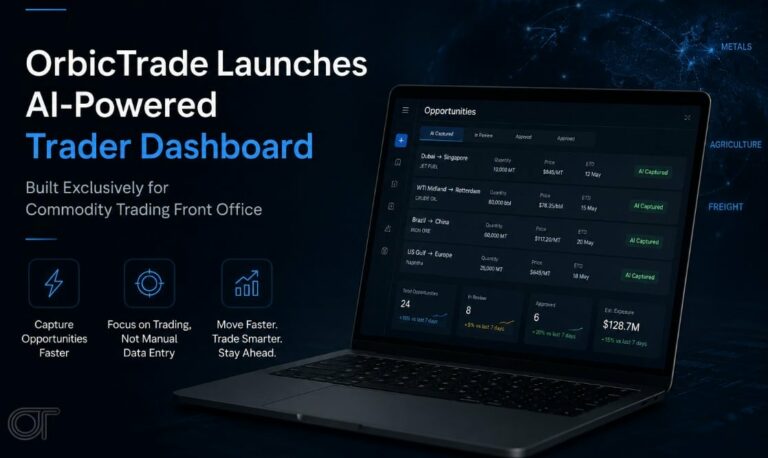
OrbicTrade has announced the launch of its next-generation AI-powered Trader Dashboard, a front-office platform purpose-built for commodity traders to streamline workflows, reduce administrative tasks and react to market opportunities more efficiently.
Built for fast-moving commodity markets, the new OrbicTrade dashboard transforms trader conversations, emails, chat messages, and trading documents into structured trade opportunities within seconds using commodity-aware artificial intelligence.

While traditional CTRM platforms were built around operational processing and complex data entry, OrbicTrade was designed for traders first, delivering a faster, cleaner, and more intuitive front-office experience.

The platform gives trading desks a live AI-powered workspace to review captured opportunities, validate commercial intent, monitor trading activity, and seamlessly push deals into existing CTRM environments.

Key Highlights Include:
  •  AI-generated trade capture directly from trader communications and documents
  •  Modern trader dashboard designed specifically for commodity desks
  •  Instant conversion of conversations into structured trade opportunities
  •  Less manual admin and repetitive deal entry
  •  Faster trade visibility and execution readiness
  •  Commodity-aware AI trained around real trading language and market terminology
  •  API-first architecture designed to integrate into existing CTRM platforms
The launch comes at a time when commodity trading desks are under increasing pressure to manage higher market volatility, tighter margins, larger data volumes, and faster decision cycles, all while operating on aging front-office infrastructure originally designed decades ago.

Industry analysts continue to highlight the growing gap between how modern commodity traders operate and the limitations of legacy trading platforms that still rely heavily on manual deal capture and fragmented communication channels.

“Commodity traders move millions of dollars of exposure in markets that can change materially within seconds. Yet many are still operating with front-office tooling that belongs in the previous generation,” said Amir Soufizadeh, Director at OrbicTrade.

“We built OrbicTrade specifically for trading desks, not operations teams pretending to serve traders. The market has been missing a true trader-first platform that understands how commodity deals actually happen.

“Commodity markets are becoming faster, more volatile, and increasingly data-driven. The firms that modernise trader interaction and front-office intelligence earliest will have a significant competitive advantage.

“OrbicTrade captures commercial intent in real time and turns fragmented conversations into structured opportunities almost instantly. Less admin. More trading.”

OrbicTrade is focused exclusively on front-office commodity trading for oil, refined products, metals, concentrates, agriculture, and freight markets.

The Rise of the AI Video Architect in Modern Production

0

A new hybrid role is transforming the video industry: the AI Video Architect. As AI-generated video becomes mainstream, production teams are combining traditional filmmaking expertise with advanced AI workflows to create faster, smarter, and more scalable content pipelines.

UK production company BearJam is among the early adopters, recently hiring a dedicated AI Video Architect as part of its growing team.

The rise of the new role is a direct result of growing AI video demand for brands across a number of industries.

BearJam has seen 87% year-on-year growth, driven by a combination of traditional video production and increasing demand for AI-powered and hybrid video projects. Other industry insights also reflect this.

In the 2026 State of Video Report by Animoto, 84% of marketers are using AI in their video creation process, and over a third of consumers trust AI-generated content as much as traditional video.

Google Trends data shows sustained growth in search interest for “AI video” over the past five years, with related terms such as “create AI video” and “AI videos” continuing to rise.

The continued interest in AI-video has paved the way for a new role within the industry, the AI Video Architect.

James Hilditch, founder and creative director of BearJam, said, “The market shifted faster than most production teams could adapt. Brands want AI-powered work, but they still want it to feel crafted and considered. That tension is what created the need for this role.”

An AI Video Architect combines creative direction and AI tooling, designs workflows using generative video, VFX, and automation, and bridges the gap between production and AI technology.

The responsibilities of an AI Video Architect include:

  • Prompt engineering for video outputs
  • AI VFX integration
  • Workflow design across hybrid production
  • Scaling content production efficiently
  • Model and tool selection across a fast-moving landscape
  • Quality curation and creative direction on AI output
BearJam recently hired Brick Ng as a permanent part of the AI video production team. Hilditch said, “Bringing Brick on as a permanent part of the team is a signal of where we’re heading. He sits between creative thinking and technical fluency, designing the workflows that let our directors and editors do their best work with AI in the mix. It’s a role we believe every serious production team will need and build teams around.”
BearJam believes roles like this will become standard across AI video production teams, not to replace creatives, but to support them in delivering high-quality content that stands out in saturated spaces.

“We use the term Craft Intelligence: the idea that AI should amplify human craft, not flatten it. The AI Video Architect is the role that applies that know-how and helps make that work day to day, bridging what’s creatively ambitious with what’s technically achievable. That’s where the most interesting work is happening right now,” added James Hilditch.
Traditionally, production involved distinct roles like directors and editors. Now, as AI tools become more integrated, these lines are blurring, creating hybrid roles that merge creative direction with AI expertise.

Brands drive this change by needing content faster and at a greater scale. Traditional production models struggle to keep up with these demands without sacrificing money and time.

This is why production companies are rethinking growth. Instead of just hiring more people, they’re integrating specialists who can manage AI-driven workflows.

As AI continues to reshape the video production landscape, roles like the AI Video Architect are likely to move from early adoption to industry standard.

For BearJam, the focus is not just on adopting new tools, but on building the internal capability to use them effectively, combining traditional production expertise with emerging AI technologies to deliver high-quality content.

With a recent move to a larger office and further hiring planned across both AI and traditional production roles, the company is positioning itself to support the next phase of growth, as demand for AI video production continues to rise.