
There are many types of therapy created specifically for people living with dementia. We spoke to Trudi Scrivener (pictured), who has more than 30 years’ experience in the care sector and is the founder of Ashridge Home Care, an award-winning specialist live-in care provider.

She is also a founder member of the not-for-profit partnership the Live-in Care Hub, a board member of The Princes Centre charity and an ambassador at the Heart of Bucks charity. As a Dementia Champion she seeks to raise awareness of how life can be improved for those living with dementia.
Art therapy
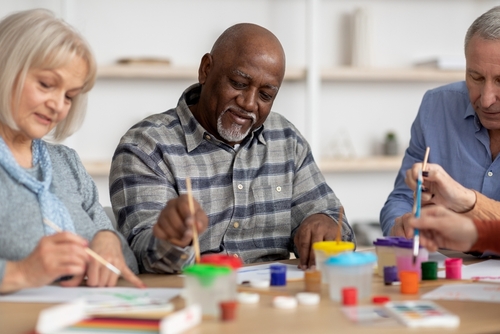
Art therapy is a powerful tool that can significantly enhance quality of life. This is because art therapy provides a different way to express emotions, connect and communicate with others when words may be hard to find.
Here, we take a brief look at what is involved in art therapy, and how it can benefit those living with dementia.
Essentially, art therapy is the use of creative activities to improve physical, cognitive and emotional well-being. It can involve activities such as music sculpting, drawing and dance, and can be a very effective form of therapy for those living with dementia. It can, in its simplest sense, help people express themselves in different ways.
Art therapy can be particularly beneficial for some of the rarer forms of dementia such as Primary Progressive Aphasia (PPA) or frontotemporal dementia (Pick’s disease) which particularly impair speech and language capabilities. These conditions often result in a total inability to speak, write and to understand the spoken or written word.
Professional art therapists are healthcare experts with knowledge of both art-making processes and psychotherapy so they have a unique combination of skills. They can accept whatever way a person with dementia chooses to express themselves and will respond to the created artworks with sensitivity and a visual literacy that can be especially beneficial for those who can no longer communicate verbally.
The benefits of art therapy for those living with dementia
There are plenty of benefits of using art therapy for those living with dementia. Some of these benefits include:
● Emotional expression – Art can be a non-verbal outlet for emotions that may be difficult to
convey such as fear, anger or joy.
● Cognitive stimulation – By stimulating different areas of the brain when being creative, this can improve problem-solving abilities as well as memory and attention span.
● Social connection – By attending a group art therapy session, this gives someone living with dementia an opportunity for social interaction. Many people living with dementia report feeling isolated and lonely. We know that loneliness has a negative impact on health, and so group activities can have a hugely positive impact on both physical and emotional well-being.
● Stress reduction – Creating art is a relaxing activity and can help reduce anxiety and agitation.
● Mood improvement – Art therapy can boost self-esteem, providing a positive outlook through a sense of accomplishment.
Research highlights the benefits of art therapies for those with dementia
These benefits are backed up by research into the enhancement of quality of life for those living with dementia. There are numerous good reasons to support art therapies for people living with dementia – and their carers – and there is no downside to trying art therapy. At the very least it helps with social interaction and belonging to a group or community.
It is also an enjoyable experience, whether the person is actually participating in creating artworks or even just as an audience member when others are creating art. That means people can gain some of the benefits even if physically incapable of making art.
Due to the multi-sensory nature of such a creative activity, and the ability to experience art in the moment, those with memory loss still experience the positive impact of the arts. Indeed, in some people it can revive old memories.
Carers can also benefit from taking the person they care for to art therapies, and enhance their own well-being too. This has a positive effect for both the carer and the cared for person.
What type of art therapy is suitable?
There are various types of art therapies that someone living with dementia could undertake depending on their individual circumstances and capabilities- options include:
● Visual arts – Sculpting, drawing, collage or painting are some of the most common types of art therapy.
● Music therapy – Creating or listening to music can be particularly emotionally impactful.
● Dance therapy – Gentle movements can help not only to improve balance and coordination, but can also improve mood.
● Drama therapy – Storytelling and role-playing can help those living with dementia to express their emotions when they cannot do so verbally.
Art therapy in practice
No matter what a person living with dementia finds interesting, there will be a type of art therapy that can be enjoyable for them. Whether this is structured activities to achieve a specific goal, or a simple exploration of different media, it can bring many benefits.